

This is my third year as a voter in the US. Because I have spent most of my adulthood as a resident alien, voting has not been part of my life. Still, observing as an outsider was not so bad. It affords me a detached and neutral perspective. Now that I am an active participant, I have formed my opinion. I see so many flaws in the current election practice. (To be very clear, I’m not echoing Donald Trump. That man’s rancor cannot be taken seriously).
Here I think not so much about big problems and national issues. I look more at mundane municipal governance, and how voters consider their role in these affairs. The prevalent thought is democracy and election is the key to good governance. It is a maxim to tell people to go to vote. Holding a complicated eight page ballot in my hand, I have a contrarian thought – don’t vote!
No, not really not to vote entirely as I stated provocatively. But I challenge the idea that elections are inherently good, lead to better governance and improved life. Rather, we are asking voters to make decisions that they are not informed about. There is no accountability for bad decisions. I argue that sometimes the best choice is to abstain.
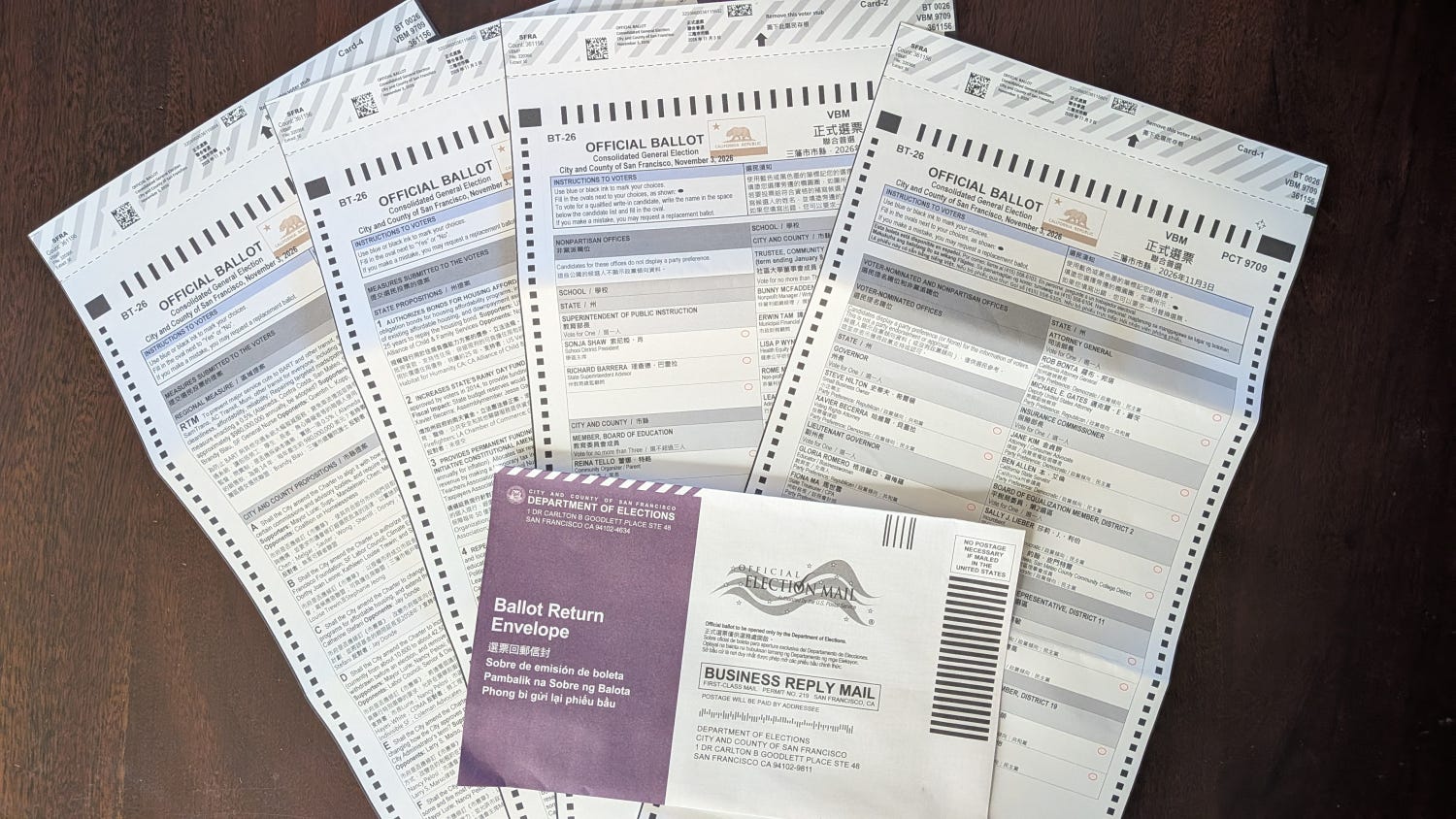
The San Francisco ballot contains 55 questions. How does it get so complicated? We know there are three levels of government in the US - Federal, State, and local, each has many political offices. Less familiar is the juridical office that’s also elected. Besides electing people, there are a set of referendums, decisions about law, tax, and political issues for people to vote on. These are known as propositions in California. The break down of the 55 questions are
Public Offices
Federal - 1
State - 10
Local - 6
Juridical - 13
Referendums
State - 14
Local - 11
We are asking a lot from the voters to understand and make good decisions for all of them. Before, my image of election day is people lining up to go to the voting booth. There, they choose the leader with good credentials, put the ballot into the voting box, and proudly walk away with an “I Voted” sticker. In reality, just carefully reading through every sentence and every name in all eight pages, even if you can make a decision instantaneously, will take you some 20 to 30 minutes. The experience is more like a grueling exam than casting a simple vote. Can we expect voters to make good decisions on the spot? In reality, I would never vote in person. It takes me hours of research at home to complete the ballot to be mailed in.
Do people really know what they are voting for? I confess I don’t know the real difference between a controller and a treasurer. Mea culpa. But do other voters understand? For the position of Board of Equalization Member, what does it really do? It sounds like an office to promote equality. On the other hand, with the benefit of the bilingual San Francisco ballot, I garner from the Chinese translation that it has something to do with tax. I wouldn’t have guessed. I am also asked “Shall Associated Justice VICTOR RODRIGUEZ to be elected to COURT OF APPEAL, FIRST DISTRICT, DIVISION THREE”. I am afraid I know nothing about Judge Rodriguez, the first district, nor division three. It is a strange idea to me that a judge is elected at all.
There is a good way to become more informed. San Francisco publishes a Voter Pamphlet in every election, with a background on every candidate and a balanced argument for and against each proposition. This year’s pamphlet is 250 pages long. Who care to read it? Or even knowing we have this resource at all?
More likely, people rely on shortcuts in their decisions. The obvious way is to apply labels, left v.s. right, liberal v.s. conservative to all subjects. This tends to make issues one dimensional and partisan. The other source is political campaigns and voices from special interest groups. This time of year, my mail box is overflowing with oversized political pamphlets. They are more or less propaganda, advocating their interest in a short slogan, painting unflattering pictures of their opponents, insinuating them as sinister villains. Surely, the most effective way to influence the vote is by provocation and emotional appeal.

For the 25 propositions, I could go through the 100 pages of arguments in the voter pamphlet to make an informed choice. Instead, my rule of thumb is to vote no on all except the few that I understand and positively support. The legislators are supposed to make these decisions, by diligently crafting the law, debate them in the council, make adjustments and build consensus. This is the job they are elected to do. Instead, we bypass this process to appeal to the voter directly with ballots, often dumb down a complex issue into a single slogan and a yes/no answer. This has been done far too excessively. If you don’t positively support a ballot but also don’t have the heart to vote no, abstain. This actively sends a signal that, even if a measure has passed, its support is limited.
That said, I endorse San Francisco proposition D, increasing the threshold to put a ballot from requiring 2% of voter signature to 8%. This will address the problem that gives us as many as 11 San Francisco propositions this year.
Many people believe more elections are necessary for democracy. They want to be involved in each and every decision. Governance becomes micromanagement by 100,000 voters, most of them lack the time and qualifications to do the job.